The year is 2026, and I find myself reflecting on the path that led us here, two years after the world first trembled at the name Frank Stone. I remember the anticipation, the swirling questions. Why did this new, terrifying story emerge from the shadows before the promised journey to the stars? The Casting of Frank Stone was not just a game; it was a deliberate, chilling pivot in the night, a single-player descent into the grim heart of the Dead by Daylight universe that arrived not as an afterthought, but as a herald. Its release in 2024 reshaped our expectations, proving that the most profound horrors are often those we never see coming.
The Unforeseen Chapter: A Shift in the Dark
Do you recall the silence that followed the crescendo of The Devil in Me? We were all looking to the stars, our minds filled with the image of a shattered shuttle adrift near Tau Ceti F, the haunting audio a siren call for the promised Directive 8020. That was to be our next destination, the premiere of The Dark Pictures Anthology's second season. Yet, the studios—Supermassive Games and Behaviour Interactive—whispered a different name into the darkness first: The Casting of Frank Stone. Was this a planned detour, or a brilliant improvisation? The reasons remain shrouded, much like the fog over Cedar Hills. This unexpected arrival taught me that in the realm of horror, the planned narrative can be upended by a more immediate, visceral fear.
Cedar Hills: A Stage for a Psychopath's Play
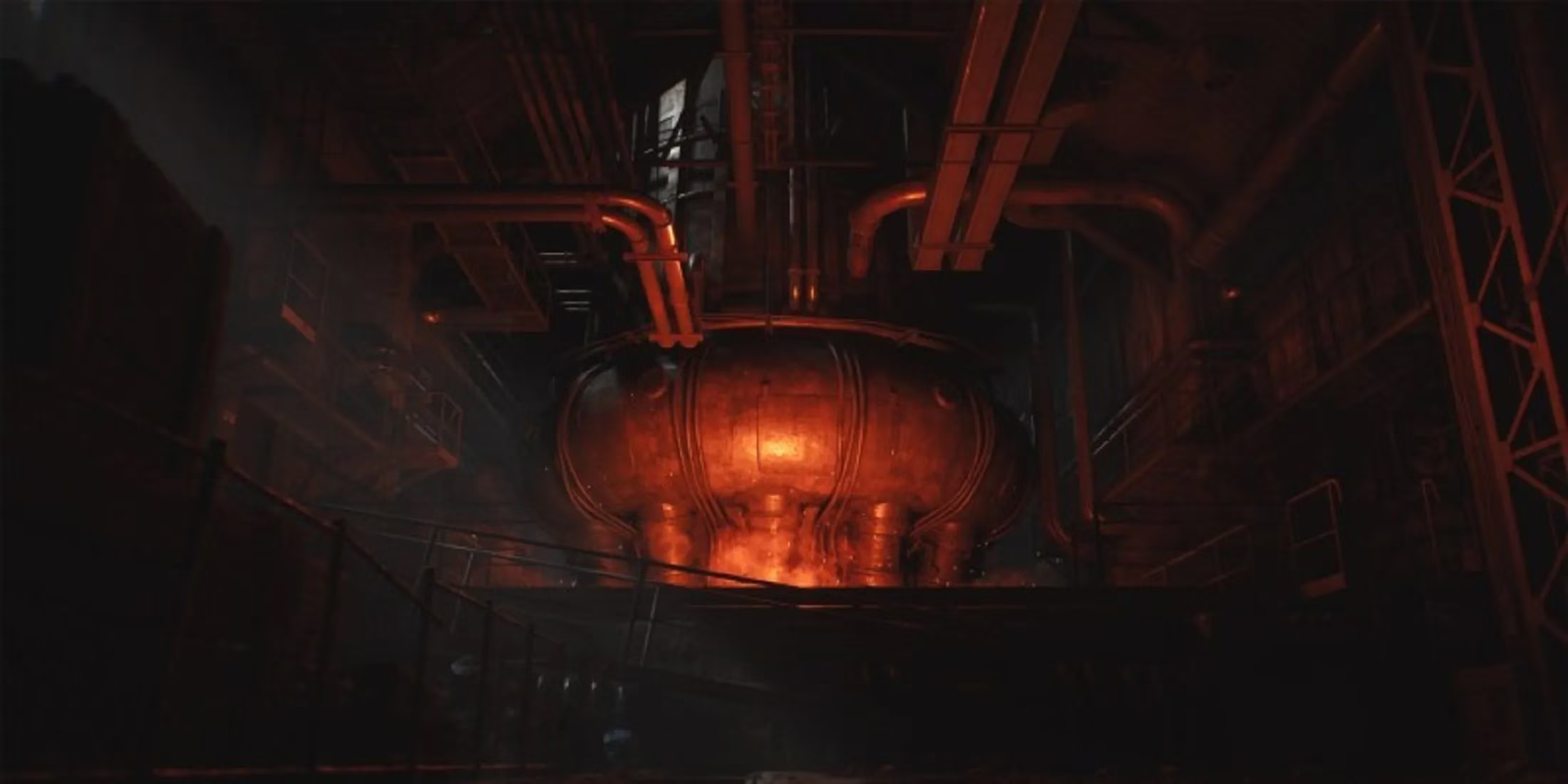
I immersed myself in that Oregon steel mill, a character among a group of friends whose curiosity became a curse. We had stepped into the domain of Frank Stone, a psychopathic serial killer who crafted his gruesome mystery not in space, but in the rust and shadow of a forgotten industry. The format was comfortingly familiar—a Supermassive hallmark where every choice I made carved a new scar into the story's outcome, where a single decision could mean the difference between a fleeting glimpse of dawn and eternal night. Yet, the setting was a world apart from the cosmic dread we had been prepared for.
Consider the contrast:
-
The Casting of Frank Stone: Earth-bound, industrial, personal horror rooted in human psychosis.
-
Directive 8020 (Anticipated): Claustrophobic, cosmic, the horror of the unknown and the void.
This divergence was the first clue that Supermassive was not merely telling another story; they were expanding their very language of fear.
Echoes and Silences: The Missing Link
As I played, I kept waiting, listening for a whisper, a hint—a post-credit scene that might bridge this brutal, grounded tale with the silent terror awaiting us in deep space. But none came. The game stood alone, a self-contained nightmare. This, perhaps, was the most significant statement of all. By not forcing a connection, the developers declared that terror has many faces, and they need not all be part of the same family. The extended wait for Directive 8020, which continued beyond 2024, allowed The Casting of Frank Stone to breathe, to establish its own legacy of dread without the shadow of an overarching anthology. It asked a poignant question: must all horror be connected, or can a standalone story sometimes scream the loudest?
A New Blueprint for Fear
Reflecting from 2026, I see how The Casting of Frank Stone was more than a stopgap; it was a blueprint. Supermassive used it to experiment, to twist their own formula. While The Dark Pictures Anthology Season 1 (Man of Medan, Little Hope, etc.) wove a connective tissue through post-credit teasers, this game demonstrated a powerful alternative: profound, isolated depth. It proved that a narrative could be utterly consuming without pointing to a next chapter. The 'casting' in the title felt like a double entendre—not just of metal, but of roles, of fates. We weren't just visitors to Frank's world; we were participants cast in his deranged production, our choices the only script.
The game's success and its stark difference have undoubtedly influenced the development of The Dark Pictures Anthology Season 2. The gap it created allowed for more meticulous crafting. If Season 1 was about linked, episodic chills, The Casting of Frank Stone suggested that Season 2 could embrace more radical, fleshed-out narratives, perhaps even varying in scope and connection. The future of horror gaming, as shaped by this pivot, looks less like a straight line and more like a web—each strand a potential new nightmare, some connected, some terrifyingly alone.
In the end, my journey through the steel mill was a reminder. Horror is not a monolith. It can be the intimate, sharp slice of a knife in a damp corner of Oregon, or it can be the vast, swallowing silence between stars. The Casting of Frank Stone arrived first to teach us that lesson, to make us fear the monster next door before we dared to fear the void above. And as we finally look toward the delayed launch of Directive 8020, we do so with a broader understanding of the dark. We are no longer just waiting for the next chapter; we are awaiting the next realm of fear, whatever and wherever it may be. The casting call for our nightmares is forever open, and the role we play is always our own to lose. 😨
Comments