As of 2026, the legacy of Dead by Daylight's temporary 'Lights Out' event continues to resonate within the community, standing as a benchmark for innovative, high-tension gameplay. Introduced in 2024, this limited-time mode was a daring departure from the game's established formula, stripping away core mechanics to deliver a pure, terrifying experience that many players now hope will make a permanent or recurring return. Unlike traditional seasonal events that primarily offer cosmetic rewards and minor gameplay tweaks, 'Lights Out' fundamentally altered the core trial experience, emphasizing raw survival horror in a way the base game rarely achieves.
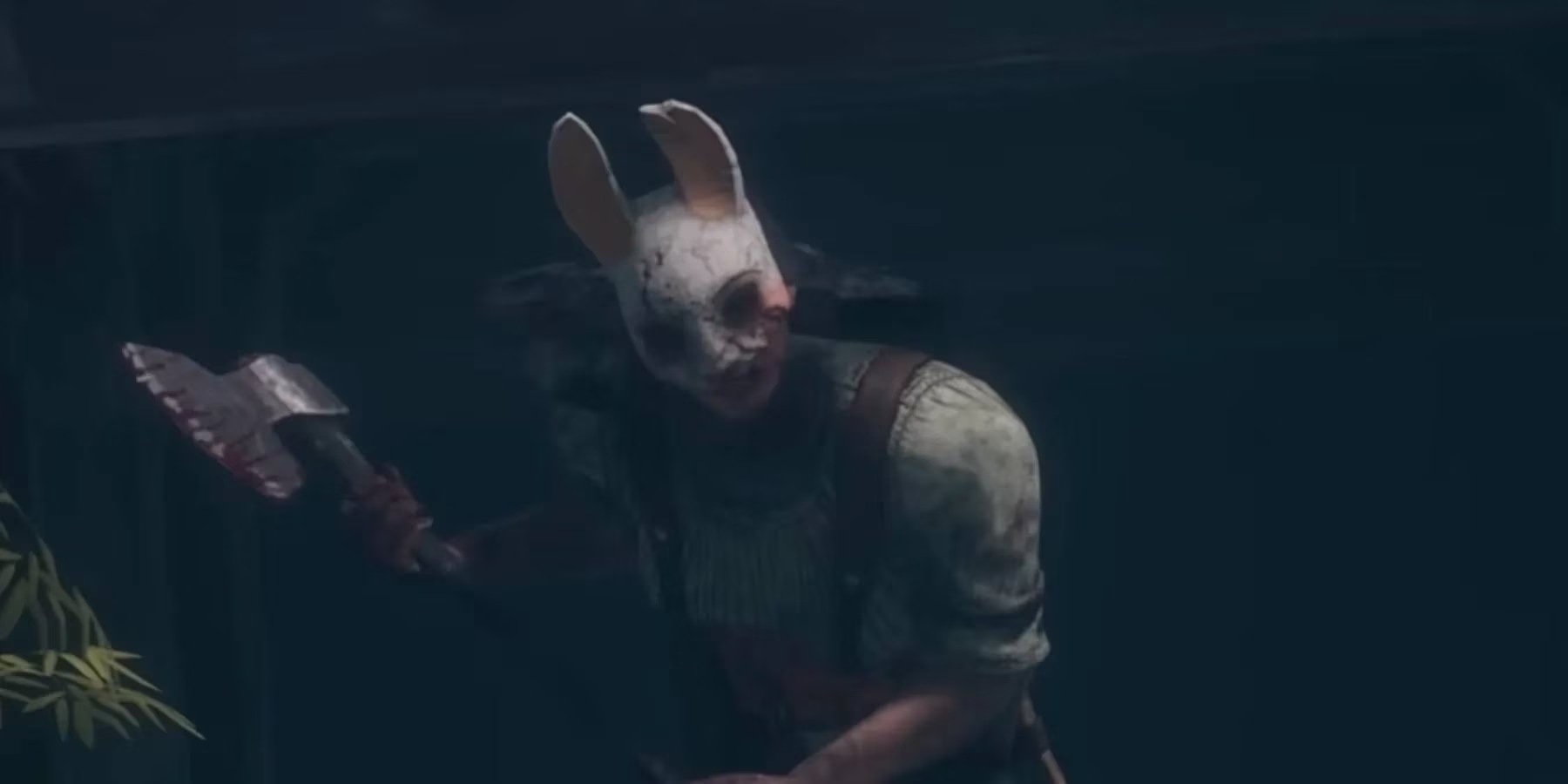
The Core Mechanics of 'Lights Out'
The premise of a 'Lights Out' trial was deceptively simple: the core objectives remained unchanged. Survivors still needed to repair generators and escape, while Killers aimed to sacrifice them to the Entity. The transformation, however, was environmental and systemic. The most immediate and impactful change was a profound, oppressive darkness that enveloped the entire map. Visibility was slashed to just a few meters for both roles, plunging every match into an atmosphere of palpable dread and uncertainty.
Crucially, the mode disabled several foundational progression systems:
-
No Perks: All character-specific perks, the building blocks of most strategies, were inactive.
-
No Add-ons: Killers could not enhance or modify their powers with add-ons.
-
No Brought Items: Survivors could not bring toolboxes, med-kits, or flashlights into the trial.
This forced all participants to rely solely on their base character abilities and whatever scarce resources they could scavenge from chests scattered around the map. The result was a brutally pure test of fundamental skill.
Why 'Lights Out' Felt Like a True 'Hard Mode'
For seasoned players, Dead by Daylight often evolves into a game of meta-knowledge, optimized builds, and perk counters. 'Lights Out' discarded this complex layer, creating what many accurately described as a 'Hard Mode' or a return to the game's horrifying roots.
| Aspect | Base Game | 'Lights Out' Mode |
|---|---|---|
| Visibility | Standard lighting, clear auras. | Severely limited, oppressive darkness. |
| Player Loadouts | Full perk builds, add-ons, items. | Base powers only. No perks or brought items. |
| Survivor Defense | Reliance on exhaustion perks, borrowed time, items. | Pure looping skill and found chest items. |
| Killer Intel | Various info perks, add-on effects. | Generator auras only; otherwise blind. |
| Core Experience | Strategic, build-focused. | Instinctual, horror-focused. |
This design had profound effects on gameplay psychology. For Survivors, every sound—a distant generator cough, the Killer's terror radius, a teammate's cry of pain—became a critical piece of intelligence in the void. The inability to rely on a 'Decisive Strike' or 'Dead Hard' for safety meant every chase was a high-stakes test of fundamental looping and mind-gaming. The tension was relentless.
For Killers, the experience was equally demanding yet uniquely thrilling. While they retained their basic power (e.g., the Huntress's hatchets, the Nurse's blinks) and could see generator auras, the loss of add-ons and information-gathering perks meant their power was unoptimized and their prey was truly hidden. This created a terrifying game of cat-and-mouse where ambushes were more effective, but finding survivors required keen auditory skills and map prediction.
The Lasting Impact and Community Desire for a Return
The 'Lights Out' event concluded as a temporary offering, but its impact has proven durable. It successfully addressed a long-standing point of feedback: that Dead by Daylight loses its horror element over time as players master its systems. By removing the mechanical crutches and plunging everyone into darkness, it restored the primal fear of the unknown.
Key reasons players and commentators cite for its success include:
-
Emphasized Core Horror: It was a masterclass in atmospheric terror, making every shadow a potential threat.
-
Leveled the Playing Field: Newer players or those without meta-perks were not at a direct disadvantage, as everyone started from the same bare-bones baseline.
-
Highlighted Foundational Skill: It rewarded game sense, map knowledge, and raw mechanical skill over perk dependency.
-
A Refreshing Challenge: For veterans, it was a thrilling and difficult palate cleanser from the standard meta.
While subsequent yearly events like the Lunar New Year and Halloween festivities continue to provide enjoyable cosmetics and bonuses, none have replicated the radical, gameplay-centric innovation of 'Lights Out'. The mode demonstrated that Dead by Daylight's formula is flexible enough to support dramatically different experiences that still feel authentic.
As the game moves forward, the question of 'Lights Out's return remains. The developers have not officially announced its permanent integration, but the overwhelmingly positive reception suggests its advantages are significant. It could potentially return as a:
-
🎃 Special annual event, similar to the 'Moonlight Burrow' offerings.
-
⚙️ A permanent alternative game mode accessible via a separate queue.
-
🏆 A weekend-only ritual to keep the experience fresh and special.
In an era where live-service games constantly seek new ways to engage players, Dead by Daylight's 'Lights Out' event stands out as a brilliant example of innovation through subtraction. It proved that sometimes, taking things away—the light, the perks, the certainty—can add more tension, fear, and fun than any new feature ever could. Its legacy is that of the purest, most terrifying version of The Entity's realm, and its potential comeback is one of the most anticipated possibilities in the game's future.
Comments